
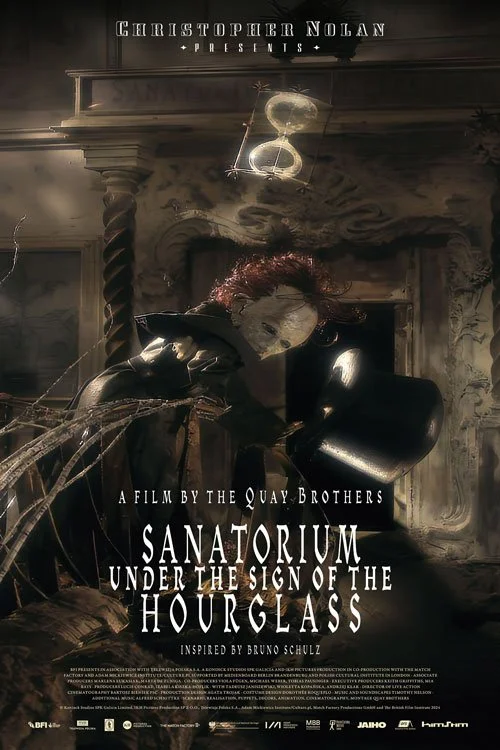
Sanatorium Under The Sign Of The Hourglass
by The Quay Brothers
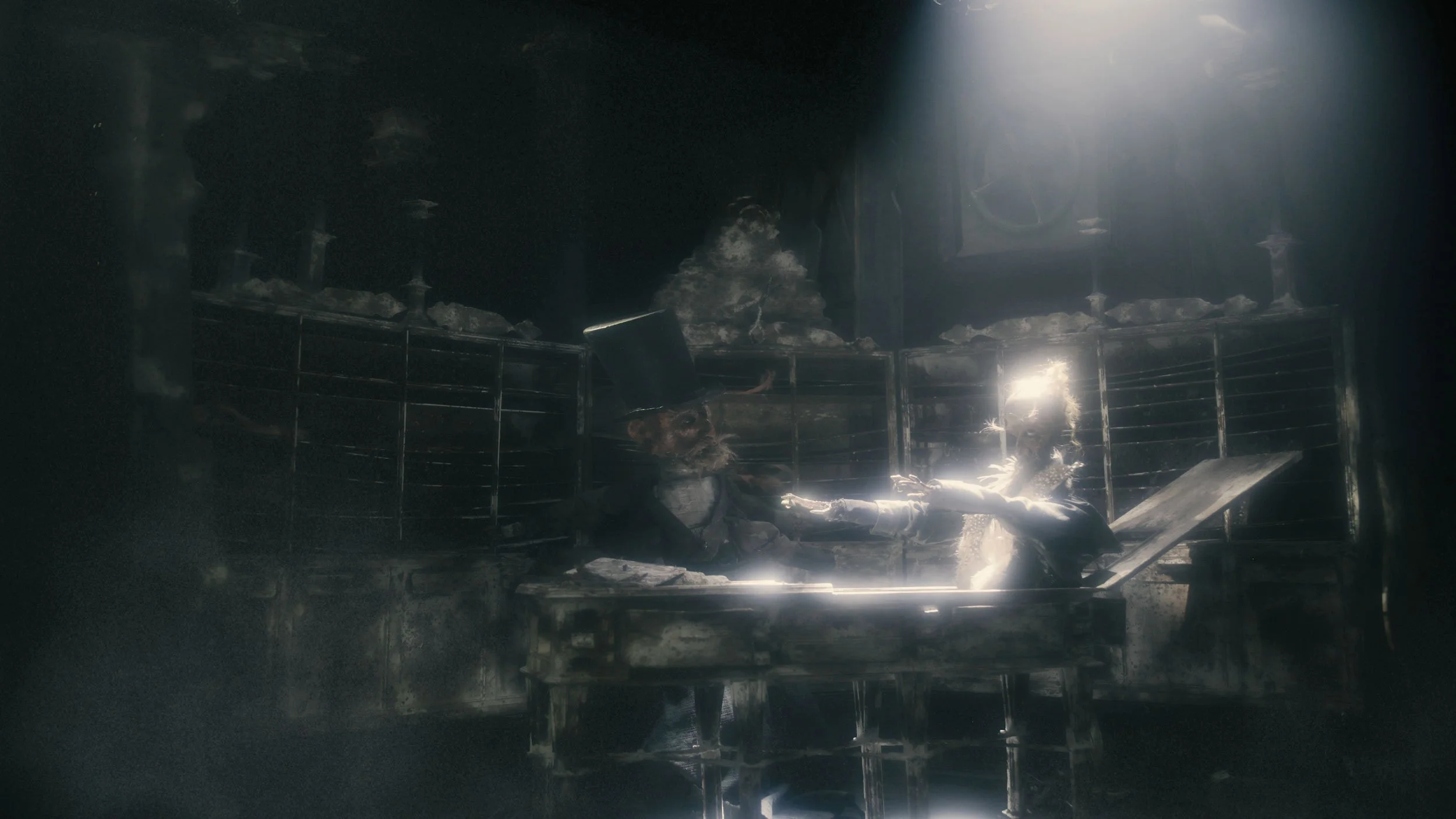
A ghostly train journey on a forgotten branch line transports a son, Jozef, visiting his dying Father in a remote Galician Sanatorium. Upon arrival, Jozef finds the Sanatorium entirely moribund and run by a dubious Doctor Gotard, who tells him that his father’s death, the death that has struck him in his country, has not yet occurred and that here they are always late by a certain interval of time of which the length cannot be defined. Jozef will come to realize that the Sanatorium is a floating world halfway between sleep and wakefulness and that time and events cannot be measured in any tangible form.
-
The Quay Brothers were born in 1947 near Philadelphia where they studied at the Philadelphia College of Art, then later in London at the Royal College of Art. In 1980 they formed Koninck with colleague Keith Griffiths and since then have produced a hybrid collection of film work: puppet animation, documentaries, interludes, commercials, and installations. They have also designed decors for the Theatre, Opera and Ballet {including filming 3 ballets}, as well as directing three live-action feature films. Many of their films have been inspired by the writings of authors including: Bruno Schulz, Franz Kafka, Robert Walser, Stanisław Lem, & Felisberto Hernández. Music is key to their work and composers include: Karlheinz Stockhausen {In Absentia}, Krzysztof Penderecki {Maska, Inventorium of Traces}, Bartók {Sonata for Solo Violin}, Witold Lutosławski {String Quartet Nr. 4}, Olga Neuwirth {The Calligrapher}, Zdeněk Liška{The Cabinet of Jan Švankmajer, The Phantom Museum}, Louis Andriessen {Theatre of the World}, Timothy Nelson {Through the Weeping Glass, Unmistaken Hands, &
Sanatorium Under the Sign of the Hourglass}, Michèle Bokanowski {The Doll’s Breath} and Alfred Schnittke {Sanatorium Under the Sign of the Hourglass}. In 2012 the QQs were the subject of a grand retrospective exhibition at MoMA, New York entitled Quay Brothers: On Deciphering the Pharmacist’s Prescription for Lip-Reading Puppets, which featured work spanning their entire career, tracing back as early as childhood, with much of the material shown for the first time.
SELECTED DIRECTORS FILMOGRAPHY
2019 The Doll’s Breath
2014 Unmistaken Hands: Ex Voto F.H.
2012 Metamorphosis
2011 Through the Weeping Glass
2010 Maska
2008 Inventorium of Traces
2007 Eurydice, She so Beloved
2004 The Piano Tuner of Earthquakes
2003 Songs for Dead Children
2002 The Phantom Museum
1994 Institute Benjamenta
1991 The Comb
1987 Rehearsals for Extinct Anatomies
1986 Street of Crocodiles
1985 This Unnameable Little Broom
-
Year: 2024
Country: United Kingdom | Poland | Germany
Runtime: 76 min
Color: Color
Language:
Subtitles: English
Sound: 5.1
-
MAIN CREW
Scenario: Quay Brothers
Realisation: Quay Brothers
Montage: Quay Brothers
Puppets, Decors: Quay Brothers
Animation Cinematography: Quay Brothers Live-action Cinematography: Bartosz Bieniek PSC
Casting Director: Paulina Krajnik PCDG Production Designer: Agata Trojak Costume Designer: Dorothée Roqueplo Make-up Artist: Anna Buttny
Sound: Joakim Sundström, Quay Brothers Re-recording Mixer: Michał Fojcik
Digital Colour Grading: Michał Herman First AD: Małgorzata Małysa
Line Producer: Małgorzata Małysa Producers: Lucie Conrad, Izabella Kiszka-Hoflik
Executive Producers: Keith Griffiths, Mia Bays Co-Producers: Viola Fügen, Michael Weber, Tobias Pausinger
Associate Producers: Marlena Łukasiak, Marta De Zuniga Music & Soundscapes: Timothy Nelson -
2024 Venice Film Festival (World Premiere) 2024 BFI London Film Festival
2025 International Film Festival Rotterdam 2022 Sitges – Catalonian International Film Festival